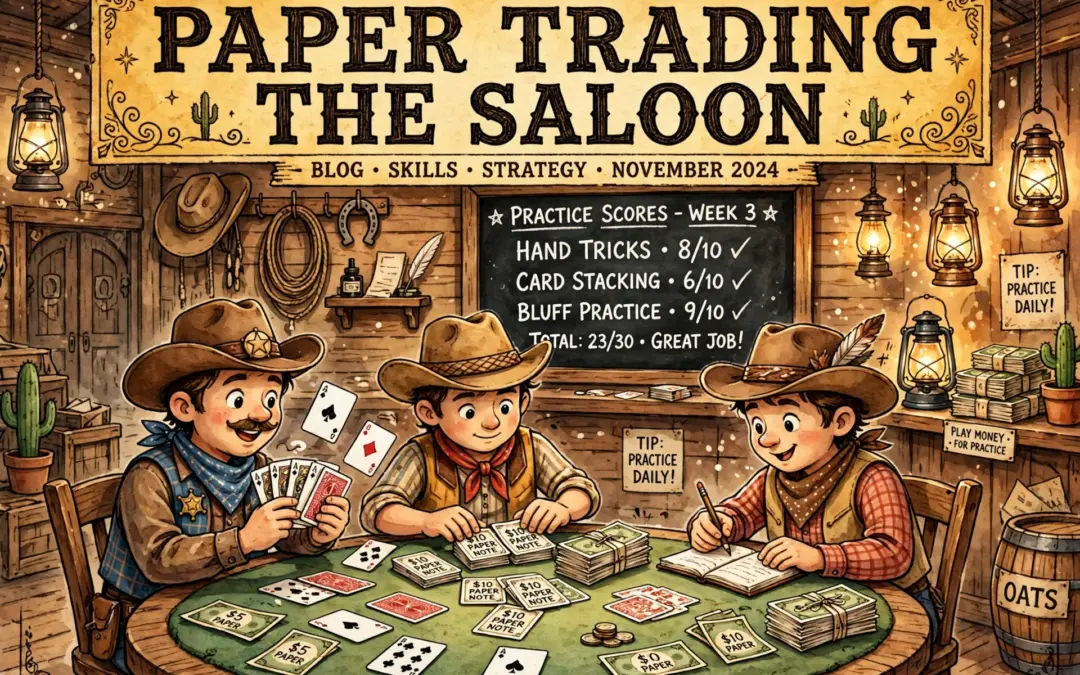
Pull up a stool, greenhorn. Every week somebody new pushes through the saloon doors with a few hundred dollars, a hot tip from the internet, and the confidence of a man who has never actually sat at the table. The market is happy to take his money. Around here, we call that tuition — and the school of hard knocks charges full price, no refunds, classes at 3 a.m.
There is a cheaper school. It’s called paper trading: making simulated trades with fake money, on real charts, at real prices. Same table, same cards, play chips. You learn how the game actually works — how to size a position, when to enter, when to walk away, and how to write it all down — before the lessons start costing you anything you can’t replace.
The Tuition Problem
Here’s what nobody tells the new folks: most early trading losses aren’t bad luck. They’re tuition paid for skills that could have been learned free. The greenhorn doesn’t know how much of his stack to put on one trade, so he puts half. He doesn’t have an exit planned, so he watches a small loss grow teeth. He doesn’t keep records, so three weeks later he can’t tell you which of his trades worked or why. He just knows he’s down, and the market feels rigged.
It isn’t rigged, mostly. He’s just paying retail price for an education. As we covered in Bob’s Saloon Lesson on why everyone buys high and sells low, the crowd’s instincts are reliably backwards — and the only cure for bad instincts is reps. Paper trading is where you get the reps.
Every trader pays tuition. The smart ones pay it in fake money first.
What Paper Trading Actually Teaches
Done properly, a paper account teaches the three skills that decide whether a trader survives his first year.
Position sizing. Before any trade, you decide how much of your total stack you’re willing to risk if you’re wrong — a small, fixed slice, the same every time. On paper, you can practice that arithmetic until it’s automatic: stake, entry, exit-if-wrong, and the loss that results. Do it fifty times with play money and the sizing stops being a guess and becomes a habit.
Entries and exits. A paper trade forces you to say, out loud and in advance: I get in here, I get out if I’m wrong there, I take profit at that level. Most beginners have never once written those three numbers down before a trade. Practicing them on a simulator — TradingView has a well-known paper trading mode built into its charts — turns a vague feeling into a plan you can grade afterward.
Journaling. Every paper trade gets a line in a notebook: date, coin, entry, exit, size, and one honest sentence about why. The journal is the real curriculum. Trades blur together in memory; ink doesn’t.
The Honesty Rules: How to Do It Without Fooling Yourself
Now, paper trading has one big cheat built in, and it’s you. Fake money is easy to be brave with, and a simulator will happily let you trade like a drunken gunslinger and occasionally win. So the saloon has house rules for practice:
- Trade the size you’d really trade. If your real account will be $500, your paper account is $500 — not $100,000. Position sizing only means something at your real scale.
- No resets. Blow up the paper account and you don’t get a fresh one until you’ve reviewed every trade that killed it. The review is the lesson; the reset is the cheat.
- Journal every trade, wins included. Especially the wins — a lucky win you don’t examine teaches worse habits than an honest loss.
- Charge yourself the fees. Real trades on an exchange like Kraken cost fees and slippage. Knock a realistic amount off every paper trade so your results aren’t flattered.
- Review weekly, same time every week. Sit down with the journal, grade each trade against the plan you wrote before it — not against how it turned out — and write down the one mistake that repeated most.
Follow those rules and paper trading stops being a video game. It becomes a rehearsal.
One more habit worth stealing from the old-timers: keep your practice sessions on a schedule, the way you’d keep a real trading routine. Two or three set times a week, same chair, same notebook, no phone buzzing on the bar beside you. Scattered, whenever-you-feel-like-it practice teaches scattered trading. A steady rhythm teaches you to show up, run your checklist, take only the trades that fit the plan, and close the book when the session ends — which, not coincidentally, is exactly how the survivors at the real table behave.
What Fake Money Can’t Teach You
Bob won’t lie to you across his own bar: paper trading has a limit, and you should know it before you start. It cannot teach you how you’ll behave when real money is bleeding. The fear is different. The greed is different. Plenty of paper champions have frozen solid the first time a real position dropped ten percent before lunch.
So treat paper results the way you’d treat a winning streak at the practice table: proof that you understand the mechanics, not proof that you’ll win at the real one. It also can’t protect you from a rigged game — spotting those is a separate skill, and we walked through it in the Saloon Doors piece on rigged token launches. Paper trading teaches you your own game. The market’s games still require your eyes open.
Graduation Day
When do you move from play chips to real ones? Not when you feel ready — feelings are how tuition gets paid. Graduate when the record says so: eight to twelve weeks of paper trades, a complete journal, position sizes you followed without exception, and a weekly review habit you’ve actually kept. Then start real, and start small — smaller than you think — because the emotional tuition is the one part nobody can pay in advance.
Do that, and when you finally sit down at the real table, you won’t be the greenhorn paying for everybody else’s drinks. You’ll be the one who already knows his numbers.
Before You Sit at the Real Table
If you want the saloon’s whole playbook in one place — position sizing, journaling templates, the crowd-psychology lessons, and the traps to walk past — that’s the Blockchain Bob Playbook ($29). New to the saloon entirely? Start with the free Starter Kit and work up. Through Monday, November 30, 2026 at 11:59 PM ET, code BLKFRIDAY7 takes 40% off the Playbook.
Nothing here is financial advice — it’s one saloon keeper’s opinion about practicing before you play. Crypto is volatile; only ever trade with money you can afford to lose.