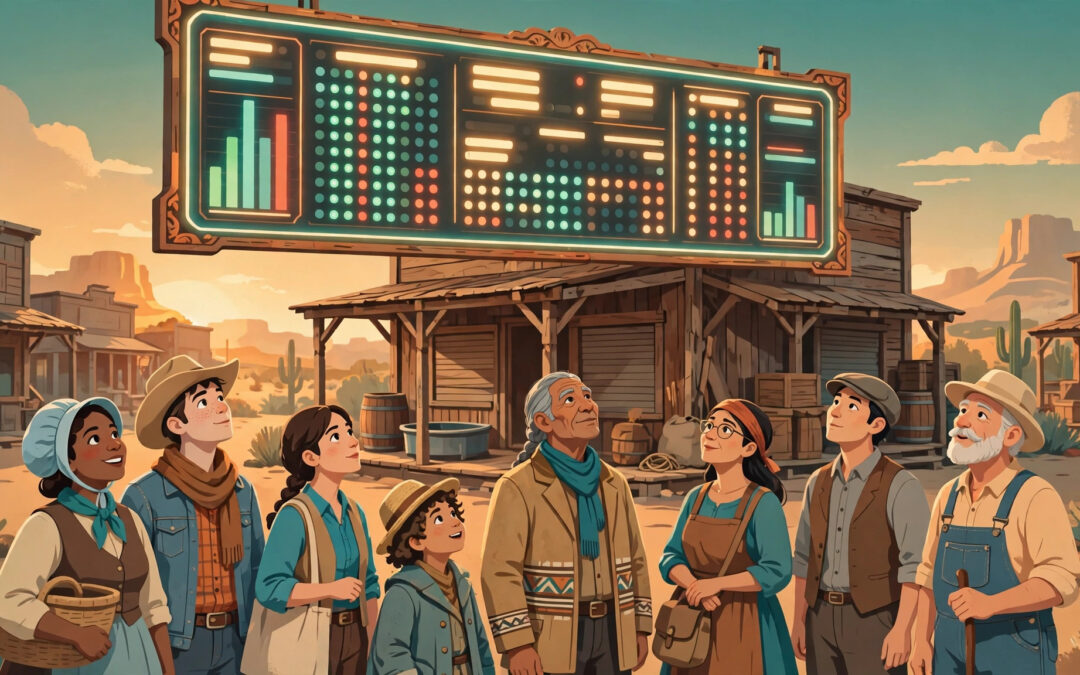
Something changed in how the news works, and you can see it on election night, game day, and just about any big day in between. The TV folks used to ask a pollster what might happen. Now they quote a price. “The market says there’s a 68% chance.” That market isn’t the stock market, partner. It’s a prediction market — and in the last month alone, the biggest ones handled roughly $137 billion in trades. Time to mosey over and see what all the fuss is about.
So What Is a Prediction Market, in Plain English?
A prediction market is a place where people trade on the outcome of a future event. Will this team win the championship? Will the Fed cut rates? Will it rain on the parade? Every question gets a simple Yes or No share, and each share trades between 1 cent and 99 cents.
Here’s the beautiful part: the price is the odds. If a “Yes” share costs 68 cents, the crowd is basically saying there’s about a 68% chance it happens. If the event comes true, that share pays out exactly $1. If it doesn’t, it pays zero. That’s the whole machine. No fancy math degree required — just folks putting real money behind what they really believe.
Think of it like the whole town gathering at the saloon, except instead of arguing over who thinks they’ll win, everybody’s opinion gets averaged into one honest number that updates every second.
Meet the Two Big Saloons in Town
Kalshi is the buttoned-up operation. It’s a fully regulated U.S. exchange — overseen by the CFTC, the same federal watchdog that supervises futures markets — where you deposit regular dollars and trade what are officially called “event contracts.” If prediction markets were frontier towns, Kalshi is the one with a sheriff, a bank, and paperwork.
Polymarket is the crypto-native outfit. It runs on a blockchain (Polygon, if you’re keeping score), trades in a dollar-pegged stablecoin called USDC, and settles everything automatically with smart contracts — no middleman holding the pot. Polymarket also runs a regulated U.S. version now, which tells you how fast the frontier is getting fenced in.
And the stampede isn’t slowing down. According to the trackers at Castle Labs and DeFi Rate, the big venues moved roughly $137 billion in notional volume in a single 30-day stretch this fall, with Kalshi holding somewhere north of three-quarters of it. (One quick vocabulary word: “notional” counts each contract at its full $1 face value, so it’s bigger than the actual cash that changed hands — but even by the stingiest counting method, we’re talking tens of billions.) Sportsbooks have noticed, too: DraftKings has launched its own prediction exchange, and other familiar gambling brands are saddling up right behind it.
Why Do These Prices Keep Beating the Polls?
Prediction markets have built a real reputation for calling elections and events more accurately than polls and pundits. Three reasons, all simple:
- Skin in the game. A poll answer costs nothing, so people say whatever feels good. A trade costs money, so people trade what they actually believe.
- They never sleep. A poll is a snapshot from last week. A market price updates the second news breaks — a debate moment, an injury report, a surprise headline.
- They average everybody. Reporters, statisticians, superfans, and sharp traders all pour what they know into one number. That’s why you’ll hear Bob say it plain: the crowd doesn’t just watch the odds anymore. The crowd is the odds.
Now the Honest Part: The Risks Nobody Puts on the Billboard
Around here we shoot straight, so here it is. Prediction markets are a powerful information tool — but they are not a crystal ball, and they are not a savings account.
- Thin markets can lie. On a small, quiet question, one big wallet can shove the price around and make it look like “the crowd” believes something it doesn’t.
- Prices can just be wrong. Crowds herd. When everybody’s scared or euphoric at once, the odds can stampede off a cliff right along with them.
- It is gambling-adjacent. Real money, real losses. Some places restrict who can trade what, and the rules are still being written. If you ever dip a toe in, treat it as entertainment with a strict budget — never rent money, never grocery money, and never because some fellow on the internet (including this one) sounded confident.
Bob’s rule for the whole crypto frontier applies double here: learn first, risk last. Watching these markets is one of the best free educations in how the world actually works. Paying tuition with your wallet is optional.
Bob’s Bottom Line
Prediction markets ate the news cycle because they earned it — they turn scattered opinions into a single, honest, always-updated number, and they do it with real money on the line. Kalshi brought them into the regulated mainstream, Polymarket proved they could run on crypto rails, and now even the sportsbooks are riding in. Whether you ever place a single trade or not, knowing how to read these odds makes you a sharper citizen of the modern frontier.
New to all this? Start where every good trail starts — with a map. Grab the free Crypto Wild West Starter Kit to learn the basics of wallets, exchanges, and staying safe out there. And when you’re ready for the full journey, The Complete Crypto Wild West Adventure & Playbook ($29) walks you through the whole territory, step by step.
See you out on the trail, partner. 🤠
This article is education, not financial advice. Prediction markets involve real risk of loss — never trade with money you can’t afford to lose.