Last time out, we rode through how prediction markets ate the news cycle — a reported $137 billion in notional volume in the 30 days to November 18, 2026, with Kalshi holding a reported 76–84% share of the flow. The crowds are arriving at the saloon doors every day now. But here’s what I keep hearing from the new arrivals, and it tells me most of them are about to learn an expensive lesson:
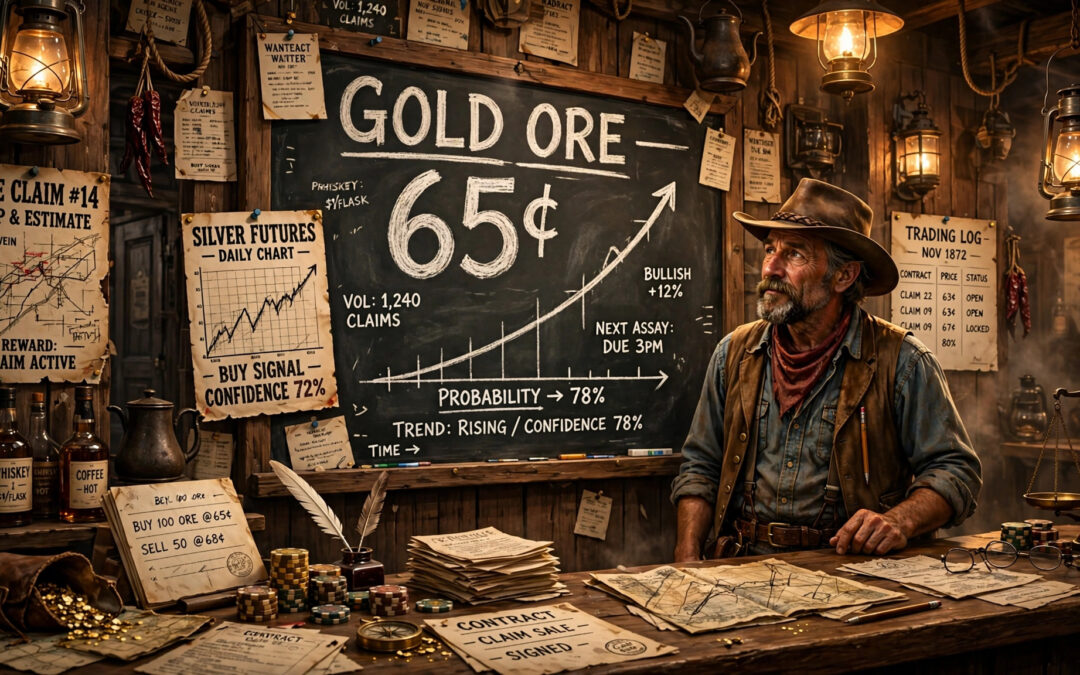
“That contract is at 65¢. Is that good?”
Friend, that question has no answer until you know what the 65¢ is actually saying. So let’s learn the single most useful idea in this whole territory — the one everything else in prediction markets hangs on.
A Price Is a Probability Wearing a Dollar Sign
An event contract is a simple critter. It pays out $1 if the event happens, and $0 if it doesn’t. That’s the whole animal. So when a contract trades at 65¢, the market isn’t giving you a tip, a prediction from a guru, or a promise. It’s giving you a number you can read as a probability:
65¢ ≈ the crowd’s collective estimate that this event has about a 65% chance of happening.
Train yourself to translate every price into that sentence. A contract at 20¢? “The market thinks this happens about 20 times out of 100.” A contract at 92¢? “The market thinks this is nearly a sure thing — about 92 times out of 100.” Once the price becomes a sentence, you can actually think about whether you agree with it. And that — agreeing or disagreeing, with reasons — is the entire game.
The Worked Example: Where “Edge” Actually Comes From
Say a contract on an event you follow closely is trading at 62¢. The market is saying roughly 62%.
Now suppose you’ve done your homework — read the primary sources, know the base rates — and your honest estimate is that this event is more like 75% likely. Then each contract has an expected payout of about 75¢ (75% × $1, plus 25% × $0), and it’s selling for 62¢. That gap — roughly 13¢ a contract before fees — is what traders call edge. You found it not by predicting the future, but by disagreeing with the price, with your homework done.
Flip it around. If your honest estimate is 50% and the price is 62¢, that same contract is overpriced for you, no matter how exciting the headline is. The price is never “good” or “bad” on its own. It’s a question the market is asking you: do you disagree — and by how much?
Three Rookie Mistakes I See at Every Saloon
1. Reading the price as a promise. A 65% event still fails about one time in three. Newcomers buy the 65¢ contract, watch the event miss, and declare the market “wrong.” The market wasn’t wrong — it told them the odds straight, and they heard a guarantee. Probabilities are not promises, and any outfit selling you certainty in this territory is selling snake oil.
2. Ignoring the spread, the fees, and thin markets. On busy markets on platforms like Kalshi and Polymarket, prices are tight and honest. On thin markets — few buyers, few sellers — the price can be stale, jumpy, or set by one loud trader. The number on the screen is only as trustworthy as the crowd standing behind it.
3. Never reading the resolution rules. Every contract has fine print that says exactly what counts as the event happening, who decides, and what source settles it. That fine print — not the headline — decides who gets paid. Reading it before you put a dollar down is the cheapest education in this business.
Why I Built the Field Guide
That one idea — price equals probability — is the first lesson. But there’s a whole trail after it: order books, hedging, bankroll rules, the traps, and how to keep a bet log that turns your mistakes into tuition instead of just losses. So I put the whole map into a book.
Prediction Markets: The Bettor’s Field Guide — A Blockchain Bob Guide is 58 pages across 4 PDFs, written in the same plain talk as everything else on this site:
- The Bettor’s Field Guide (26 pages) — 13 chapters plus a glossary: event contracts, odds as probabilities with worked examples, the five market types, platform differences, liquidity and fees, resolution risk, bankroll rules and position sizing, reading the order book, hedging, and the watchlist-and-news routine.
- Workbook & Bet Log (16 pages) — drill worksheets with answer keys, the 10-point pre-bet checklist, two printable bet-log formats, a bankroll tracker, and a weekly review template with a trap audit.
- BONUS: Insider Secrets & AI Playbook (11 pages) — the practitioner tells (read the resolution source first, spot the liquidity tells, why the first headline move is usually wrong), an honest AI forecasting playbook with a 12-prompt copy-ready library, and a 30-day action plan, week by week.
- BONUS: Your First Market in 7 Steps (5 pages) — the whole process, in order, for your first walk down Main Street.
New to Bob’s territory entirely? Start free with the Crypto Wild West Starter Kit. Want the full crypto trail — wallets, safety, scams, and the works — ride with The Complete Crypto Wild West Adventure & Playbook. And for the wider crypto-and-AI frontier beyond this site, my partners at Martini Labs cover it daily.
The Trailhead Is This Way
Prediction markets are going to keep growing, and the folks who do well in them won’t be the loudest guessers — they’ll be the ones who can read a price, translate it into a probability, and calmly decide whether they disagree. That’s a learnable skill, and this guide teaches it step by step.
Get Prediction Markets: The Bettor’s Field Guide on Gumroad — $17
Fifty-eight pages, four PDFs, one honest map of the territory. Read the first lesson free right here in this article — then take the whole guide with you.
This article and the Field Guide are education, not financial advice. Prediction markets involve real risk of loss; never wager money you can’t afford to lose.