Reading the Table Before You Sit Down
Every Western has the same scene. A stranger rides into town, finds a poker game already running, and sits down with his whole stake in his hat. The regulars smile. They’ve been waiting for him all week.
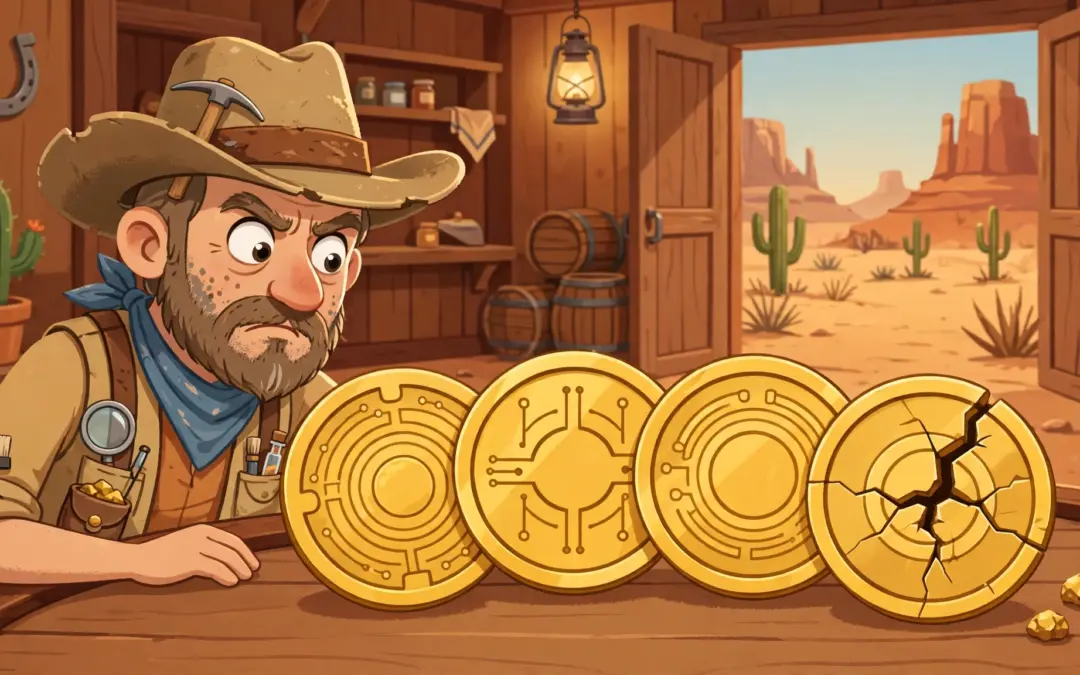
A new token launch works the same way. The game started before you arrived — the supply was dealt, the first hands were played, and some of the players at the table are working together. The saloon doors swing both ways, partner: you can walk in, but you can also walk right back out. This guide teaches you to read the table before you ever touch your wallet.
In a rigged game, the most dangerous moment is the one where you’re winning.
Early green candles feel like proof you picked right. In a rigged launch, that early pump is often the bait itself — priced in by the folks who got their tokens for nearly nothing and need your buy to become their exit.
Trick One: The Bundled Deck (Bundled and Sniped Supply)
When a token launches, the first buys happen in the same second the token exists. Insiders use bundles — many wallets buying at once, coordinated by the launch team or by sniper bots — to grab a huge share of the supply at the lowest possible price.
Why it matters to you:
- One posse, many hats. Fifty wallets holding 2% each looks decentralized. If they’re all one bundle, it’s one rider holding half the town.
- Your buy becomes their payday. When bundled wallets sell, they sell together, and the price falls off a cliff.
- The chart lies early. A launch that rockets in minute one often just shows insiders buying from themselves.
What to look for: launch-checker tools and the token’s holder list. If a big cluster of wallets bought in the very first block and hold similar amounts, you’re looking at a bundled deck.
Trick Two: The Crowded Saloon That’s Mostly Mirrors (Fake Volume)
A busy saloon looks like the place to be. Crooked barkeeps in the old West hired men to stand at the bar. In crypto, it’s wash trading: the same money cycling between wallets to fake trading volume and make a token trend on listing sites.
Signs of a mirrored crowd:
- Huge volume, tiny holder count. Real crowds bring people. Fake volume brings transactions but few new wallets.
- Round, robotic trades. The same buy and sell sizes repeating like a player piano.
- A chart that saws up and down in place. Real demand moves a price and keeps discovering new levels; wash volume spins in a circle.
Volume is the easiest number to fake and the first number beginners trust. Trust the holder count more.
Trick Three: The Floorboards That Aren’t Nailed Down (Liquidity)
Liquidity is the pool of money that lets you sell. Think of it as the saloon’s floor: you assume it’s solid until you step through it.
Two questions decide whether the floor holds:
- Is the liquidity locked or burned? Locked liquidity (in a time-lock contract) or burned liquidity (sent to an address nobody controls) can’t be pulled quickly. Unlocked liquidity can vanish in one transaction — that’s the classic rug pull.
- How deep is the pool compared to the price action? A token “worth” millions on paper with only a few thousand dollars of real liquidity means early sellers exit fine and everyone else fights for the door.
If nobody can tell you plainly whether liquidity is locked, for how long, and where you can verify it — the floor is not nailed down.
Trick Four: The Stranger Wearing a Famous Name (Copycat Tickers)
In every boomtown, somebody opens a saloon with a famous name painted on the sign and no connection to the original. Copycat tokens copy the name and ticker of a real project — sometimes launching before the real token exists, sometimes minutes after a big announcement.
Greenhorn defense is simple:
- Never buy from a ticker alone. Always use the official contract address from the project’s own website or verified channels.
- Beware announcement snipers. When a real project says “token coming soon,” fakes appear within the hour.
- Check the age and the source. A token whose only “announcement” is a reply under someone else’s post is a painted sign, not a saloon.
Trick Five: The Piano Player on Payroll (Undisclosed Paid Posts)
When the piano player starts singing about how honest the card game is, ask who’s paying for the music. Influencer posts about new tokens are frequently paid promotions — sometimes disclosed, often not. A famous account posting “just found this gem” about a token that launched twenty minutes ago is not research; it’s advertising, and the advertiser usually holds a bag bought cheaper than yours.
The U.S. Federal Trade Commission requires paid endorsements to be disclosed, and its cryptocurrency scam guidance is worth a read before your first launch season. The SEC’s investor site makes the same point for investment promotions generally, in its crypto investment scam alerts.
Insights: What the Old Hands Know
- You are the liquidity. In a rigged launch, the insiders’ profit doesn’t come from the token succeeding. It comes from you buying after them. Every check below exists to answer one question: who gets out, and at whose expense?
- Speed is the trap’s trigger. Rigged launches rely on FOMO — buy now, research later. Anything that punishes a ten-minute pause is designed to.
- Boredom is a strategy. The tokens that survive a year rarely needed you in the first hour.
The Greenhorn’s 10-Minute Pre-Buy Checklist
Run these before any new-token buy. All of them are free, and you can verify most on a public explorer like Solscan:
- Holder spread: Do the top 10 wallets hold a scary share? Did many wallets buy in the first block with similar amounts (bundle sign)?
- Holder count vs. volume: Hundreds of thousands in volume but only dozens of holders? Mirrors, not a crowd.
- Liquidity status: Locked or burned — and can you see the proof yourself, not a screenshot?
- Contract address: Copied from the project’s official site, not from a post, reply, or DM?
- The name check: Is this the real project, or a copycat riding a famous name?
- Who’s talking: Are the loudest promoters disclosing payment? Did they “find” it suspiciously early?
- Sell test: Can you see real sells happening, or only buys? (Some scam tokens block selling entirely.)
- The one-sentence test: Can you say, in one sentence, why a stranger would buy this from you later at a higher price — for a reason that isn’t “the chart is going up”?
If a launch fails two or more of these, the saloon doors swing both ways. Walk out.
Ride Safe, Then Ride Far
None of this makes you a gunslinger overnight, and it isn’t meant to. It makes you the one rider the rigged table can’t use. If you want the full trail map, start with the free Crypto Wild West Starter Kit — and when you’re ready for the whole expedition, The Complete Crypto Wild West Adventure & Playbook ($29) goes deep on wallets, safety drills, and reading a market like a trail. More trail guides live back at the Blockchain Bob homepage.
And if you enjoy markets where the odds are printed on the tin, ride over to our piece on reading a prediction market price like a probability.
Education only, not financial advice. New token launches are among the riskiest corners of crypto; most new tokens go to zero. Never buy with money you can’t afford to lose, and never let a countdown clock make your decisions.