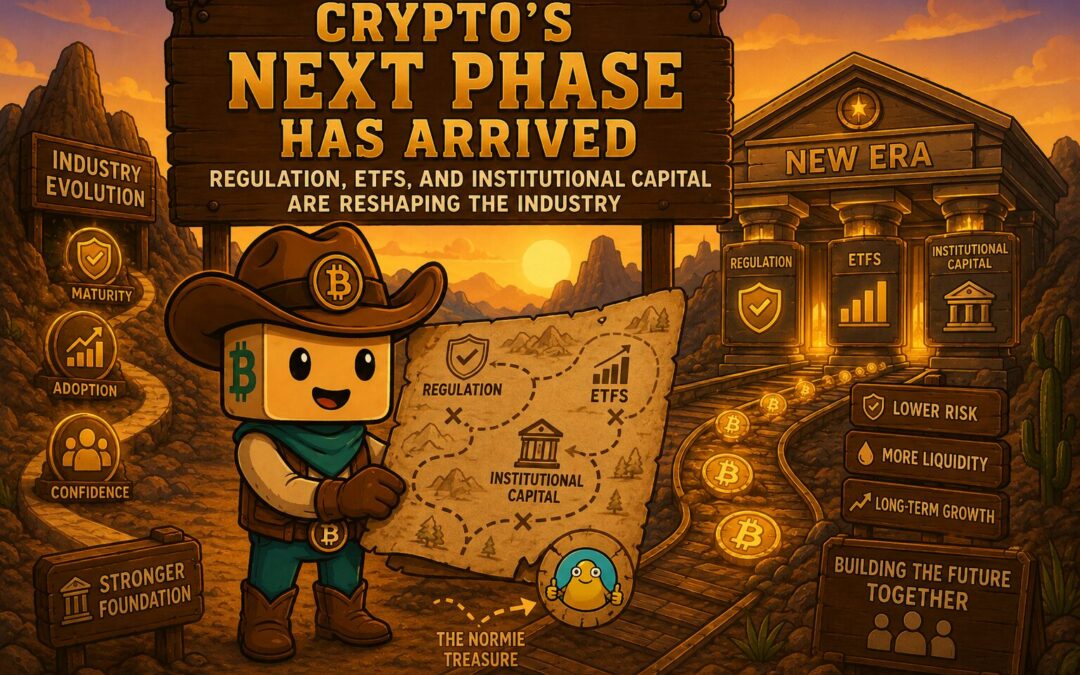
Crypto’s Next Phase Has Arrived: Regulation, ETFs, and Institutional Capital Are Reshaping the Industry
For years, cryptocurrency existed in a strange gray zone.
It was dismissed by many governments.
Ignored by traditional finance.
Viewed as speculative internet money.
And often treated more like a rebellious experiment than a legitimate financial sector.
But something fundamental is changing.
Today’s biggest crypto developments reveal a much larger transformation underway:
Crypto is no longer fighting to survive.
It’s integrating into the global financial system.
And the implications could be enormous.
Normie — The Future of SocialFi Is Human
Where Psychology, AI, Meme Culture, and Community Collide – CLICK HERE

The Clarity Act May Become a Turning Point for Crypto
One of the biggest stories today is the continued momentum behind the Clarity Act, a major U.S. crypto market structure bill advancing through the Senate Banking Committee.
At first glance, regulation may sound boring compared to meme coin rallies or massive price swings.
But in reality, this could become one of the most important moments in crypto’s modern history.
Why?
Because for years, one of the largest barriers preventing major institutional adoption has been uncertainty.
Institutions hate uncertainty.
Large financial firms need clarity around:
- securities laws
- custody rules
- taxation
- stablecoin regulations
- exchange oversight
- compliance standards
The Clarity Act aims to answer many of those questions by helping define:
- when tokens are securities
- when they are commodities
- how crypto firms should operate
- how stablecoins are regulated
- which agencies oversee various sectors
That matters enormously.
For over a decade, crypto operated in a fragmented regulatory environment where many companies simply didn’t know what rules applied to them.
Now governments are slowly beginning to build frameworks instead of simply resisting the industry.
And that changes the psychology of the market.
Bitcoin Above $80K Is More Than Just a Price Level
Bitcoin holding around the $80,000 range is not just a technical milestone.
It’s symbolic.
Not long ago, Bitcoin was viewed as:
- internet speculation
- fringe technology
- “magic internet money”
- an anti-establishment experiment
Today:
- governments discuss Bitcoin reserves
- pension funds gain exposure
- ETFs trade on Wall Street
- universities allocate capital
- multinational firms hold BTC on balance sheets
That is an extraordinary shift in perception.
Markets are now reacting less to hype cycles alone and more to:
- ETF flows
- macroeconomic conditions
- monetary policy
- institutional positioning
- regulatory developments
Bitcoin increasingly behaves like a macro asset.
And psychologically, the $80K level reinforces the idea that Bitcoin is becoming normalized inside global finance.
The ETF Revolution Is Quietly Reshaping Crypto
One of the clearest themes emerging today is that:
ETFs are becoming the bridge between traditional finance and crypto.
The ETF structure removes enormous friction for institutions.
Large investors no longer need to:
- manage wallets
- secure private keys
- navigate exchanges
- interact directly with blockchain infrastructure
Instead, they gain exposure through familiar financial products.
This is one reason why Bitcoin ETFs became such a major catalyst.
But what’s even more interesting now is that institutional interest is rapidly expanding beyond Bitcoin.
Dartmouth’s Crypto Allocation Signals Something Bigger
One of today’s most revealing developments came from Dartmouth College’s endowment disclosure showing exposure to:
- Bitcoin ETFs
- Ethereum ETFs
- Solana staking ETFs
This may sound like a small story on the surface.
But it reflects a much larger trend:
Crypto is moving deeper into traditional capital allocation systems.
University endowments historically invest in long-term transformational technologies and asymmetric opportunities.
When universities begin allocating to crypto products, it signals growing confidence that blockchain technology may become part of future financial infrastructure.
This is especially important because institutions often move slowly.
By the time large endowments publicly disclose positions, the research and due diligence likely happened years earlier.
That suggests institutional conviction is quietly growing beneath the surface.
Solana Is Emerging as a Major Institutional Narrative
Solana continues attracting increasing attention from institutional investors.
Why?
Because institutions are looking beyond “digital gold” narratives toward:
- scalable blockchain infrastructure
- real-world transaction throughput
- AI integrations
- tokenization ecosystems
- staking yield opportunities
Solana’s appeal comes from its positioning as:
- high-speed
- low-cost
- developer-friendly
- scalable
In many ways, institutions increasingly view Layer-1 blockchains as infrastructure plays.
Not unlike investing in:
- internet infrastructure
- cloud computing
- payment rails
- operating systems
The rise of Solana ETFs reflects this shift.
Institutions are no longer just buying crypto as speculation.
They are beginning to invest in blockchain ecosystems they believe could power future applications.
Bitwise’s Hyperliquid ETF Shows the Market Is Evolving Fast
Perhaps one of today’s most fascinating developments was Bitwise launching a spot ETF focused on Hyperliquid (HYPE).
This is significant because it signals a major evolution in institutional crypto thinking.
The first wave of institutional adoption focused almost entirely on:
- Bitcoin
- Ethereum
Now institutions are starting to explore:
- DeFi infrastructure
- decentralized trading systems
- on-chain perpetual markets
- advanced blockchain financial architecture
That is a very different level of sophistication.
It suggests crypto is evolving from:
simple asset exposure
toward:
exposure to decentralized financial infrastructure itself.
Hyperliquid represents part of a broader trend where decentralized trading systems increasingly compete with traditional exchanges.
This could become one of the next major battlegrounds in finance.
Ethereum Still Faces a Narrative Challenge
Ethereum remains one of crypto’s most important ecosystems, but it continues struggling relative to Bitcoin in the current market environment.
Part of this comes from Bitcoin’s growing role as:
- digital reserve asset
- institutional entry point
- macro hedge
- ETF-driven liquidity magnet
Meanwhile Ethereum’s narrative is more complex.
Its strengths remain substantial:
- staking infrastructure
- DeFi dominance
- tokenization layers
- smart contracts
- Layer-2 expansion
- developer ecosystem
But complexity sometimes slows institutional understanding.
Bitcoin is simple:
digital scarcity.
Ethereum requires deeper understanding around:
- gas economics
- scaling architecture
- staking dynamics
- Layer-2 ecosystems
Still, long-term institutional accumulation of ETH continues quietly because many investors believe Ethereum could become foundational infrastructure for tokenized finance.
The Real Story Is Institutionalization
The deeper story behind all these developments is not simply regulation or ETFs.
It’s the institutionalization of crypto itself.
We are now witnessing:
- governments adapting
- Wall Street integrating crypto
- universities allocating capital
- financial infrastructure evolving
- tokenization accelerating
- AI + crypto ecosystems expanding
Crypto increasingly resembles an emerging financial sector rather than a fringe movement.
That does not mean volatility disappears.
It doesn’t mean speculation ends.
But it does suggest the industry is maturing into something much larger.
The Industry Is Moving From Speculation to Infrastructure
Early crypto cycles were largely driven by:
- retail hype
- speculative trading
- ideological movements
- rapid volatility
The next phase may be increasingly driven by:
- infrastructure
- institutional capital
- tokenization
- financial integration
- AI-powered systems
- real-world applications
That’s a major evolution.
The market is gradually shifting from:
“Should crypto exist?”
to:
“How will crypto integrate into global systems?”
That is a completely different conversation.
Why This Matters Beyond Finance
The implications extend far beyond investing.
Blockchain technology is increasingly intersecting with:
- AI
- identity systems
- tokenized assets
- gaming
- creator economies
- global payments
- behavioral data
- decentralized coordination
This is why many analysts believe we are still in the early stages of a much larger digital transformation.
Not just a financial trend.
But potentially:
a restructuring of how value moves across the internet itself.
Final Thoughts
Today’s crypto news reveals something important:
The industry is no longer operating purely on the outside of traditional finance.
It is slowly merging with it.
The Clarity Act, ETF expansion, university allocations, Solana adoption, and institutional DeFi exposure all point toward the same conclusion:
Crypto is becoming infrastructure.
And as regulation becomes clearer, institutional capital grows, and blockchain ecosystems mature, the next phase of crypto may look very different from the chaotic cycles of the past.
Less fringe.
More integrated.
Less experimental.
More foundational.
The industry still faces challenges.
Volatility remains.
Regulation is still evolving.
But one thing is becoming increasingly difficult to ignore:
The financial world is no longer asking whether crypto matters.
It is beginning to ask how large its role in the future economy could become.

Normie — The Future of SocialFi Is Human
Where Psychology, AI, Meme Culture, and Community Collide
Normie transforms viral personality polls, “Would You Rather” questions, and human behavior into a community-driven SocialFi ecosystem powered by AI, behavioral insights, and tokenized engagement. Discover how your choices compare with the world — and become part of a movement mapping real-time human psychology and internet culture.
🧠 Explore your personality.
🔥 Compare your answers.
🌍 Join the movement early.
👉 Visit Normie.one
💬 Join the community: Telegram
𝕏 Follow on X: @Normie765714