79% of Pump.fun Coins Die on Day One. Now It Costs More to Play.
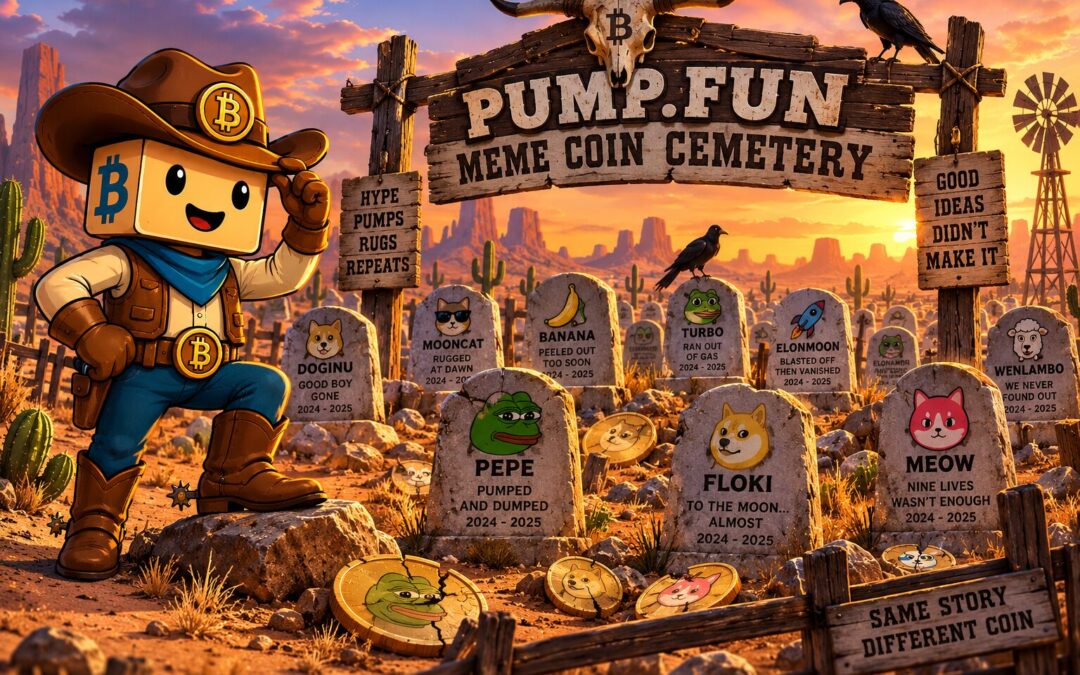
Nearly four out of five tokens launched on Pump.fun never see a second day of trading. That finding comes from a new Bitquery study covering November 2025 through October 2026, and it landed the same week Pump.fun started charging an extra fee to people trading through its own app.
Put those two facts side by side and the math for the average memecoin trader gets worse. The odds that a coin survives were already slim. Now each trade on the main app costs a little more too.
The timing matters. Memecoins as a category are worth roughly $29.9 billion, according to CoinGecko’s October 18 snapshot, with about $3.4 billion changing hands in a day. Dogecoin alone accounts for around $12.4 billion of that, Shiba Inu about $2.9 billion and Pepe about $1.6 billion. That’s real money, and most of it sits in a handful of old names, not in the thousands of fresh launches that appear every day.
The survival numbers
Bitquery tracked Pump.fun launches over roughly a year, and the drop-off is steep:
- 79% of tokens traded only on the day they launched. After that, nobody bought or sold them again.
- About 1.5% had even one trade in their fifth week.
- 1 in 58 launches (about 1.7%) “graduated” from Pump.fun’s starter bonding curve to a full trading pool.
A quick note on graduation. Every Pump.fun coin starts on a bonding curve, a built-in pricing formula that raises the price as people buy. Once a coin attracts enough buying, it moves to a regular trading pool on PumpSwap. Graduation is the closest thing a launchpad coin has to proof that real demand showed up.
This isn’t a one-off finding. A separate CoinGecko analysis from June looked at 18.6 million tokens launched between January 2024 and June 2026. It found about 69% stopped trading on their first day, 80% were done within two days, and only 4.5% traded for more than three months. The two studies used different time windows and methods, but they point the same way: most coins are dead within hours.
What this means in practice: if you buy a random new launch, the base rate says it will very likely have no buyers tomorrow. Any strategy has to beat those odds before it makes money.
How Meteora DBC compares
Meteora’s Dynamic Bonding Curve (DBC) is a rival launch tool on Solana. Its coins look healthier on day one but end up in about the same place.
| Launchpad | Traded only on launch day | Still trading in week five |
|---|---|---|
| Pump.fun | 79% | ~1.5% |
| Meteora DBC | 51% | 1.9% |
Source: Bitquery, via crypto.news.
The day-one gap is big: almost half of Meteora coins get at least a second day of trades, versus about one in five on Pump.fun. But by week five, the difference shrinks to less than half a percentage point.
The takeaway is that switching launchpads doesn’t change the long-term odds much. A coin on Meteora may linger a bit longer, but fewer than 2 in 100 are still trading a month later on either platform.
The new fee: what it costs you now
On October 17, Pump.fun added a platform fee to trades made through its website and mobile app. According to its fees page, the fee is 0.45% of each trade, or 0.40% if you signed up with another user’s referral code. Part of the fee on referred trades goes to the person who referred you.
The key detail: this fee is on top of what Pump.fun already charges. Trades on the bonding curve already carry a 1.25% fee (0.95% to the protocol, 0.30% to the coin’s creator). Here’s how a trade on a brand-new coin stacks up now:
| How you trade | Fee per trade | Buy + sell (round trip) |
|---|---|---|
| Pump.fun app, no referral | 1.70% | ~3.4% |
| Pump.fun app, with referral | 1.65% | ~3.3% |
| Terminal or a third-party front end | 1.25% + that app’s own fees | ~2.5% + that app’s own fees |
Round-trip figures are approximate, since fees are charged on the value of each trade.
In plain terms: on the main app, a fresh coin has to rise about 3.4% just for you to break even after buying and selling. That’s before Solana network fees, priority tips or slippage, which can be much bigger on thin, new tokens.
The fee doesn’t apply to Pump.fun’s Terminal product or to third-party trading apps and bots. Those tools may charge their own fees, though, so the savings depend on what you use. The fees page also says Pump.fun may lower or waive the platform fee for some wallets or time periods.
The bigger picture: where memecoin money is (and isn’t) going
The launchpad numbers fit a wider pattern. Across crypto, prices have climbed while trading activity has cooled.
The market is up, but trading is down. CoinGecko says total crypto market value rose 39.6% in the third quarter. Over the same period, average daily trading volume fell 8.6%, and spot trading on centralized exchanges dropped 14.2% to $1.65 trillion. Higher prices on less trading can mean fewer new buyers coming in, and new buyers are what memecoins depend on.
Wall Street’s Dogecoin experiment is ending. Bitwise is shutting down its Dogecoin ETF (ticker BWOW) less than a year after it launched in November 2025. Its last day of trading was October 14, and remaining shareholders get cash on October 22. Decrypt reports the fund held only about $722,000 in early September. If the biggest memecoin can’t draw much traditional money, newer ones shouldn’t count on it either.
Robinhood Chain’s memecoin spike has faded. CoinGecko says Robinhood’s blockchain has handled more than $88.9 billion in trading since it launched on July 1. Its main exchange peaked at $3.5 billion in daily volume on September 4, during a frenzy around the CASHCAT coin. Activity has since dropped: from October 2 to 8, transactions averaged 42% below mid-September levels.
The Fed meets October 27–28. Memecoins are among the riskiest assets in crypto, so they tend to swing hardest when interest-rate expectations change. Next on the calendar after that is U.S. inflation data for October, due November 10.
What to take from it: ignore the “100x” lists, watch the base rates
Scroll any crypto news feed this month and you’ll find lists of “100x meme coins to buy in October.” They all skip the two numbers that decide most outcomes: how often coins survive, and how much each trade costs.
Here’s why those two numbers matter more than any pick:
- Survival is the starting point. If roughly 98 of every 100 launches stop trading within a month, a few big wins have to cover a lot of losses. Most traders who chase new launches are, by the math, buying coins that will soon have no buyers.
- Fees add up fast. At about 3.4% per round trip on the app, ten quick in-and-out trades eat nearly 30% of the money you started with, even if every coin goes nowhere. Frequent traders feel this the most.
- Your front end now matters. The same trade costs different amounts depending on where you place it. Check what Terminal or your bot of choice charges before assuming it’s cheaper.
- Graduation is a useful filter. A coin that made it off the bonding curve has at least shown real demand. Only about 1 in 58 does, so waiting for that signal rules out most of the field, though it’s no promise a coin will last.
- Size bets for the base rate, not the dream. If you trade new launches, assume most positions will go to zero and only risk what you can afford to lose.
The launchpad business still works for the platforms: every trade pays a fee, whether the coin lives or dies. For traders, the new numbers are a reminder that the house edge just got a little bigger.
This article is for information only and isn’t financial advice. Memecoins are highly speculative, and you can lose your entire investment.
Sources
- crypto.news: Memecoin outlook for Q4 2026 (Oct 18, 2026): Bitquery survival data, CoinGecko market figures, Robinhood Chain, fee change
- Pump.fun fees page (updated Oct 17, 2026): platform fee and bonding curve fees
- Decrypt: Bitwise to close Dogecoin ETF: BWOW dates and assets
- ForkLog: CoinGecko study on Pump.fun token lifespan (Jun 25, 2026): earlier survival data