Would You Rather Own Your Data or Give It Away Forever?
Summary:
Your personal data is no longer just digital exhaust — it is becoming one of the most valuable assets in the AI economy. The future will belong to platforms that let users own, control, protect, and potentially earn from the data they create every day.
Key Takeaways:
- Data ownership is power: Every click, search, opinion, and purchase creates value, and users should have more control over who uses that information.
- AI makes data more valuable: As AI systems become smarter, personal data will be used to train models, personalize experiences, and predict behavior.
- The old internet extracted data: Big platforms monetized user behavior while users received little ownership or upside.
- The next internet may be user-owned: Data wallets, decentralized identity, AI agents, and tokenized rewards could turn personal data into an asset controlled by the individual.
Every click is a confession.
Every search is a clue.
Every purchase is a signal.
Every opinion, answer, like, scroll, pause, swipe, share, comment, follow, and reaction says something about who you are, what you value, what you fear, what you want, what you might buy, what you might believe, and what you might do next.
For years, most people have treated this data casually. We click “accept.” We sign up. We scroll. We post. We answer quizzes. We use free apps, free search engines, free social networks, free maps, free email, free video platforms, free AI tools, and free digital services. In exchange, we give away little pieces of ourselves.
At first, it seemed harmless.
What is one click worth?
What is one search worth?
What is one poll answer worth?
What is one opinion worth?
Individually, maybe not much. But at massive scale, human data has become one of the most valuable resources in the world. Platforms learned that if they could collect enough behavior, they could predict attention. If they could predict attention, they could sell advertising. If they could sell advertising, they could build empires.
The modern internet was not built only on information. It was built on extraction.
We gave away our data, and companies turned it into money.
Now artificial intelligence is making the question even more urgent. Data is no longer just used to sell ads. It can be used to train models, personalize digital agents, predict decisions, build psychological profiles, automate persuasion, map communities, shape recommendations, and create increasingly accurate simulations of human behavior.
The question is no longer simply: “Do you want privacy?”
The deeper question is:
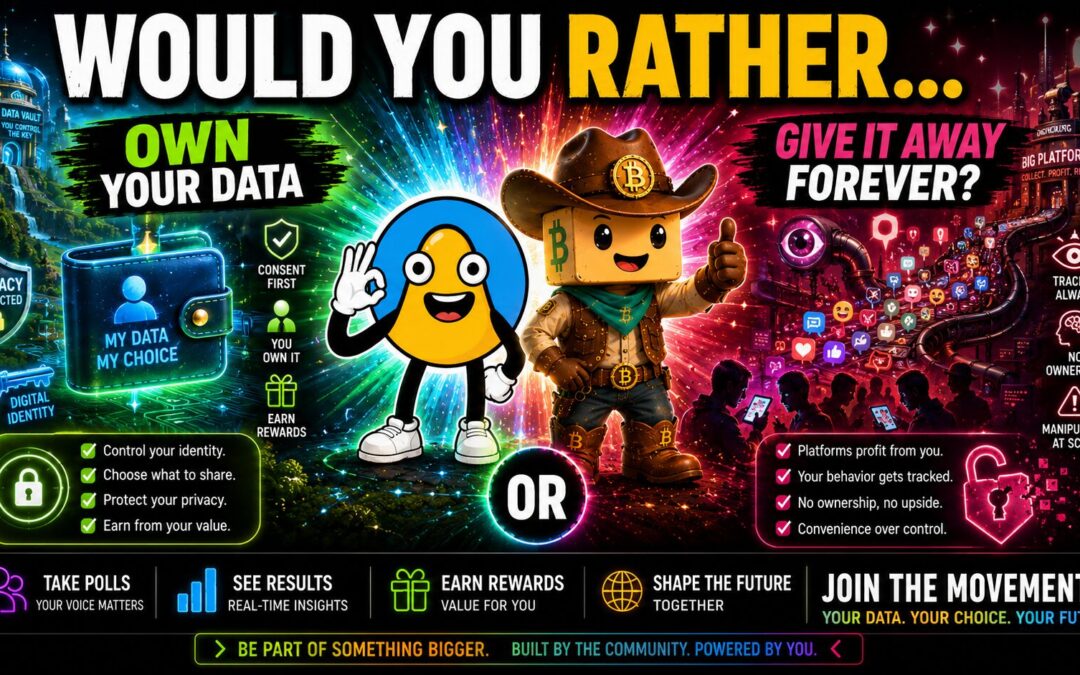
Would you rather own your data or give it away forever?
The Invisible Economy Built From Your Behavior
Most people understand that companies collect data, but few truly grasp the scale of it. The digital world records behavior constantly. It remembers what you clicked, what you ignored, how long you stayed on a page, what you typed and deleted, what you searched at midnight, what products you considered but did not buy, what videos you watched twice, and what ideas made you angry enough to comment.
This is not just “data” in the cold technical sense. It is a behavioral map.
Your data tells a story about you.
It reveals your habits, preferences, desires, routines, social circles, emotional triggers, financial interests, health concerns, political leanings, entertainment tastes, relationship patterns, learning style, risk tolerance, and identity. Over time, your digital footprint becomes a kind of shadow version of yourself — a machine-readable personality built from thousands of small actions.
The old internet asked users to create content.
The new internet studies users as content.
Every human being online becomes both a participant and a product. You are not simply using the platform. In many cases, you are helping build the platform’s intelligence. You are training its recommendation engine. You are improving its ad targeting. You are giving it more information to sell, analyze, refine, and monetize.
This is why “free” is rarely free.
The cost is not always money. The cost is control.
The Great Data Trade
For the last two decades, the dominant digital bargain has been simple: platforms provide convenience, users provide data.
You get free search, free social media, free maps, free email, free videos, free apps, and free communication tools. In return, platforms collect information about you and use it to build powerful business models.
For many people, this trade seemed acceptable. After all, these tools are useful. They connect us, inform us, entertain us, and help us navigate the world. But the problem is that users rarely understood the true value of what they were giving up.
Data was treated like exhaust — a byproduct of digital activity.
But it was actually fuel.
The more people used digital platforms, the smarter those platforms became. The smarter the platforms became, the more valuable they became. The more valuable they became, the more dependent people became on them. A cycle formed: users created the value, platforms captured the wealth.
This is the core tension of the data economy.
The people producing the raw material usually do not own the final product.
You create the behavior. The platform owns the profile.
You create the content. The platform controls the reach.
You create the engagement. The platform sells the attention.
You create the signal. The platform captures the intelligence.
This model worked because users did not have many alternatives. If you wanted access to modern digital life, you had to play by the platform’s rules. But that may be changing.
AI Makes Personal Data More Valuable Than Ever
Artificial intelligence changes the value of data because AI feeds on patterns.
The more data an AI system has, the better it can predict, personalize, recommend, generate, automate, and influence. In the age of AI, your data is not just a record of what you did yesterday. It may become the foundation for what machines think you will do tomorrow.
This is powerful — and dangerous.
On the positive side, personal data could help AI become incredibly useful. Imagine an AI assistant that truly understands your goals, schedule, health patterns, communication style, financial preferences, learning habits, career ambitions, and personal values. Instead of generic answers, it could provide personalized guidance. Instead of being just a chatbot, it could become a digital coach, planner, assistant, researcher, and life management system.
But on the negative side, the same data could be used to manipulate people with terrifying precision.
If platforms know what makes you anxious, they can keep you scrolling.
If advertisers know what makes you insecure, they can sell you a solution.
If algorithms know what makes you angry, they can feed you outrage.
If political campaigns know what you fear, they can target your emotions.
If AI agents know your weaknesses better than you do, persuasion becomes almost invisible.
This is why data ownership is not just a business issue. It is a human issue.
The more intelligent machines become, the more important it is that people have rights over the data used to understand them.
The Rise of Data Sovereignty
Data sovereignty means individuals should have meaningful control over their personal information. They should know what is being collected, how it is being used, who benefits from it, and whether they can remove it, transfer it, protect it, or monetize it.
In simple terms, data sovereignty asks:
Who owns the digital version of you?
Is it you?
Or is it the platform?
This question will define the next era of the internet.
In the old model, data was trapped inside platforms. Your social graph belonged to one company. Your reputation belonged to another. Your purchase history belonged to another. Your search history belonged to another. Your content, followers, preferences, and identity were fragmented across closed systems.
You could use the platform, but you could not truly take yourself with you.
This is why creators can build massive followings and still feel powerless. A platform can change the algorithm, reduce reach, demonetize content, suspend an account, or alter terms overnight. The creator may have built the audience, but the platform controls access.
Data sovereignty flips this model.
It imagines a future where users own their identity, preferences, reputation, credentials, contribution history, and behavioral data across platforms. Instead of being locked inside closed systems, your data could move with you. You could choose what to share, with whom, under what terms, and for what value.
That is not just privacy.
That is power.
Your Data Should Work for You
The next major shift may be moving from data extraction to data participation.
In the extraction model, users create data and platforms monetize it.
In the participation model, users create data and share in the value.
This could change everything.
Imagine answering polls, contributing opinions, reviewing products, sharing insights, joining communities, completing missions, training AI systems, verifying information, or participating in research — and being rewarded for it. Not because you are being manipulated into engagement, but because your participation creates measurable value.
This is where ideas like SocialFi, decentralized identity, tokenized communities, reputation systems, and Decentralized Engagement Organizations become important.
A DEO, or Decentralized Engagement Organization, is built around the idea that engagement itself can become economically meaningful. People do not just follow a brand or join a platform. They participate, contribute, verify, create, share, learn, and help build the network. In return, they can receive recognition, reputation, rewards, governance rights, or ownership.
This is a huge shift.
Instead of attention being harvested, attention becomes accounted for.
Instead of engagement disappearing into platform analytics, engagement becomes part of a visible contribution ledger.
Instead of users being treated as free labor, users become stakeholders.
This could apply to content platforms, health communities, creator networks, learning systems, gaming platforms, sports communities, AI training networks, local communities, and even professional organizations.
The internet has already proven that people will participate. The missing piece is giving them ownership in the value they help create.
The Personality Economy
One of the most interesting frontiers of data ownership is personality data.
People love answering questions about themselves. They take personality quizzes, play “Would You Rather?” games, vote in polls, compare opinions, reveal preferences, and join conversations around identity. This kind of data is powerful because it is not just transactional. It is expressive.
It tells us how people think.
It reveals values, emotions, motivations, decision-making styles, moral instincts, communication patterns, risk preferences, social behavior, and personal identity.
In the past, platforms collected this type of data mainly for targeting and engagement. But in the future, personality data could become something users own and use.
Imagine a personal AI that understands how you make decisions. Imagine a social platform that helps you discover compatible communities based on values instead of just viral content. Imagine a learning system that adapts to your motivation style. Imagine a health assistant that understands whether you need accountability, encouragement, structure, or emotional reassurance. Imagine a marketplace where users can selectively share anonymized preference data and get rewarded for contributing to better products, research, or AI models.
The value is enormous.
But the danger is also obvious.
Personality data is intimate. It can help people understand themselves, but it can also be used to manipulate them. That is why ownership, consent, transparency, and user control matter so much.
The future of personality data should not be a hidden psychological extraction machine.
It should be a user-owned identity layer.
Why “I Have Nothing to Hide” Misses the Point
Whenever data ownership is discussed, some people say, “I do not care. I have nothing to hide.”
But privacy is not only about hiding bad behavior.
Privacy is about human dignity.
It is about context. It is about consent. It is about freedom from constant monitoring. It is about the right to grow, change, experiment, learn, fail, and think without being permanently profiled.
You may not care if one company knows what shoes you like. But what happens when hundreds of companies know your fears, habits, health concerns, political emotions, income level, location patterns, relationship status, and psychological vulnerabilities?
You may not care about today’s data collection. But what about tomorrow’s AI systems that can analyze your entire digital history?
You may not care now. But what happens when your data affects your insurance, employment, credit, dating, reputation, opportunities, or social standing?
The issue is not whether you have something to hide.
The issue is whether you have something to protect.
And everyone has something to protect.
Data Ownership Does Not Mean Data Isolation
Owning your data does not mean hiding everything. It does not mean disconnecting from the internet, refusing personalization, or rejecting AI.
In fact, the best future may be one where people share more data — but on better terms.
There is a difference between forced extraction and voluntary participation.
People may be willing to share health data if it helps cure disease. They may share shopping preferences if it improves recommendations. They may share learning data if it helps them grow. They may share community data if it strengthens belonging. They may share behavioral insights if they are rewarded fairly.
The problem is not data sharing.
The problem is data exploitation.
A better model would allow people to decide what they share, how long it is shared, who can access it, what it can be used for, and whether they receive value in return. This could include privacy dashboards, personal data vaults, portable digital identities, blockchain-based permissions, tokenized incentives, decentralized reputation systems, and AI agents that negotiate on behalf of users.
The future may not be less data.
It may be better data relationships.
The Role of Blockchain and Web3
Blockchain is often discussed in terms of money, speculation, and tokens. But one of its most important long-term roles may be digital ownership.
The internet made information easy to copy.
Blockchain made digital ownership easier to prove.
That matters for data.
A blockchain-based identity or permission system could allow users to prove ownership, manage access, track contributions, and receive rewards without relying entirely on centralized platforms. Smart contracts could help define how data is used. Tokens could reward participation. Decentralized credentials could prove reputation. On-chain records could create transparent contribution histories.
This does not mean every piece of personal data should be public on a blockchain. That would be a mistake. Personal data must be protected carefully. But blockchain can provide the ownership, permission, and settlement layer around data without exposing everything.
In other words, blockchain may not store your private life.
It may help enforce your rights over it.
This becomes especially important as AI agents begin acting on behalf of humans. If personal AI agents manage our schedules, finances, health insights, content, communities, and digital identities, they will need secure permission systems. They will need to know what data they can use, what they can share, and what they can negotiate.
AI needs intelligence.
Blockchain can provide ownership.
Together, they may create a new model for user-controlled digital life.
The Future: Personal AI Agents and Data Wallets
One of the most powerful ideas for the next decade is the personal data wallet.
Just as a crypto wallet can hold digital assets, a data wallet could hold permissions, preferences, reputation, credentials, contribution history, identity signals, and personal AI context. Instead of every platform building its own isolated profile of you, you could maintain your own trusted profile and decide where to use it.
Your data wallet might include:
Your interests.
Your skills.
Your content history.
Your reputation.
Your verified contributions.
Your learning progress.
Your health preferences.
Your community memberships.
Your social graph.
Your values.
Your AI personalization settings.
Your consent rules.
Your reward history.
Then your personal AI agent could help manage that data. It could decide what to share, block exploitative requests, recommend opportunities, negotiate compensation, and help you benefit from your own digital identity.
This could create a new kind of internet experience.
Instead of platforms owning the user profile, the user brings the profile to the platform.
Instead of starting from zero on every app, your trusted digital identity travels with you.
Instead of companies extracting behavioral data silently, they request permission openly.
Instead of users being passive sources of data, users become active managers of their digital selves.
This is what true personalization should look like.
Not surveillance.
Sovereignty.
The Ethical Challenge
Of course, data ownership will not be simple.
There are hard questions.
How do we protect people from selling sensitive data too cheaply?
How do we prevent scams and exploitative data markets?
How do we make privacy tools easy enough for normal people?
How do we verify data without exposing identity?
How do we reward participation without turning every human action into a transaction?
How do we stop powerful platforms from recreating the same extraction model with new language?
These questions matter.
A future where people own their data should not become a future where people are pressured to monetize every part of themselves. Human dignity must remain above market value. Some data should be protected, not sold. Some parts of life should remain private, sacred, and outside the reach of optimization.
The goal is not to turn humans into walking data products.
The goal is to stop treating humans like unpaid data mines.
Ownership should give people more freedom, not more pressure.
The New Social Contract of the Internet
The old social contract of the internet was:
Use this platform for free, and we will take your data.
The new social contract should be:
Bring your data with consent, and share in the value you create.
This new model could reshape the relationship between users and platforms. Platforms would still create useful tools, communities, and experiences. But users would no longer be invisible suppliers of value. They would be recognized participants.
Creators would own more of their audience relationships.
Communities would own more of their engagement.
Users would own more of their identity.
AI systems would be trained with clearer permission.
Brands would build trust through transparency.
Data would become less of a hidden extraction machine and more of a negotiated relationship.
This is not just a technical upgrade. It is a philosophical one.
It asks whether the internet should be built around human agency or platform control.
The Big Question
So, would you rather own your data or give it away forever?
At first, the answer seems obvious. Of course people should own their data. Of course people should have control. Of course people should benefit from the value they create.
But the real challenge is not agreeing with the idea.
The real challenge is building the systems that make it possible.
We need better digital identity tools. Better privacy design. Better AI transparency. Better user education. Better incentives. Better data wallets. Better reputation systems. Better community ownership models. Better legal frameworks. Better platforms that treat users as partners instead of products.
The good news is that the shift has already begun.
People are becoming more aware of the value of their attention, identity, and behavior. Creators are questioning platform dependence. Communities are exploring tokenized ownership. AI is forcing society to rethink consent and training data. Web3 is offering new models for digital property. SocialFi is experimenting with user-owned engagement. DEOs are imagining a world where participation becomes equity.
The future of data will not be decided only by governments or corporations.
It will be decided by what people demand.
Conclusion: From Extracted to Empowered
For too long, the internet turned human behavior into corporate wealth without giving users meaningful ownership, control, or participation in the upside. We created the signals. We created the engagement. We created the content. We created the social graphs. We created the attention. We created the data.
But platforms captured most of the value.
Now, as AI becomes more powerful, the stakes are higher. Personal data is no longer just used to sell ads. It may shape the intelligence systems that guide decisions, filter reality, automate work, personalize medicine, influence culture, and define opportunity.
That means data ownership is not a niche issue.
It is one of the defining questions of the digital age.
The next generation of platforms should not be built on extraction. They should be built on consent, transparency, participation, and shared value. The future should not belong only to companies that collect the most data. It should belong to people and communities that control their data wisely.
Your data is not digital waste.
It is not meaningless exhaust.
It is not something you should give away without thought.
Your data is a reflection of your life.
Your choices.
Your identity.
Your attention.
Your intelligence.
Your humanity.
And in the age of AI, that may make it one of the most valuable things you have.
So the question remains:
Would you rather own your data?
Or give it away forever?